A SEA OF HUMANITY: India, Part I
October 8, 2025
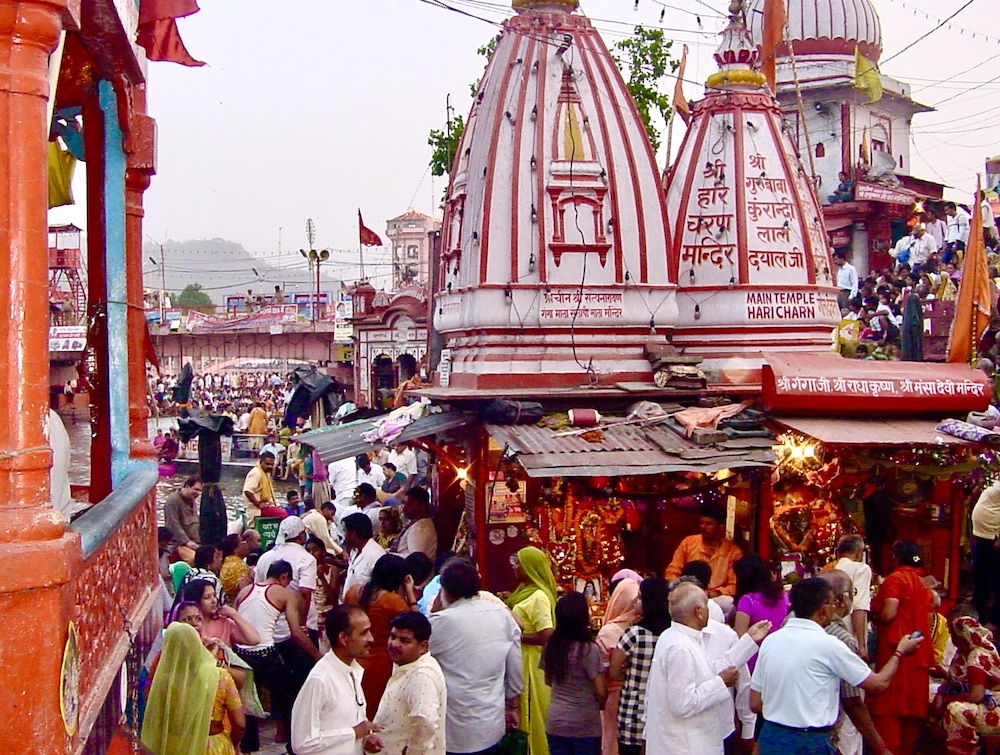 |
| INDIA: Kumbha Mela, Ganges River |
Travel changes my world. It broadens my understanding of who and what I am on this planet, along with eight billion other souls who are fellow companions and teachers. I enter other cultures to understand how they’ve made sense of this great cosmic journey we’re on together. I want to hear about their mythology and spiritual lives; I want to visit, and when possible, sit in their sacred places, and take part in local rituals. Stories of violence, loss and triumph move me, not as ancient history, but as long-ago events that trickle down into daily life.
I come home utterly transformed each time I venture out from the tree-filled safety of my neighborhood. My heart, soul and body are stretched, often painfully so, and filled with experiences and inexplicable events that shape-shift inside me for years, like autumn leaves falling from trees, onto the quiet forest floor of my being. They become a part of me.
And so it was with India, or perhaps, especially with India.
I had been drawn to India much of my life--its exotic spices and varied regional clothing. And later, its complex textiles, music, spiritual philosophies. I thought of the American poet Walt Whitman’s exuberant phrase: Passage O soul to India![1] celebrating how this remarkably complex country would be more accessible through the wonder of the newly opened Suez Canal in 1869. I remembered the racial oppression and conflicts explored in E.M. Forster’s book “A Passage To India”[2], titled as a nod to Whitman. It examined through story the stratified cultural pain of the Indian people under the hundred-year rule of the British Raj, although British imperial control started long before that, with the British East India Company, chartered in 1600. Originally a merchant trader for spices, it became an economic powerhouse and a pre-cursor of the British Raj.
But my own connection to India came not from these different but brilliant creative works, but from deep engagement over three decades with several wisdom traditions, all jewels of contemplative philosophy; all with an original lineage through what is now, since the Partition of the Indian subcontinent in1947, the country of India.
An ashram community in the US where I had spent years as a student was filled with statues, paintings, rugs and artwork featuring the spiritual bounty of India, and I had taken it in, during those early years, like a traveler who had come a long distance with little sustenance. It quenched a deep longing I had felt for seemingly forever. I had longed to see the birthplace of these remarkable traditions through its diverse people, along with India’s architectural wonders and the natural beauty of the mountains and countryside. The planet’s largest spiritual celebration, the Maha Khumba Mela occurred there, too, of course, rotating between four sacred cities along the banks of the Ganges River. The celebration lasted about four months, and the time was set according to Vedic astrologers. It drew over fifty million people who came to take part in a multitude of daily activities and healing rituals.
Spiritual friends and fellow retreat-goers spoke of evenings with thousands of people chanting, the Ganges scented by incense and lit by thousands of candles floating on small rafts, as many waded or immersed themselves in the river. I longed to join in, but years passed, and I settled into my psychotherapy practice. It was enough to teach yoga and meditation along with my clinical caseload, and maintain my own practice within my spiritual community. Years passed.
~
And then suddenly I had tickets to India. My new husband and I decided to travel there. Not as a honeymoon, but as a dedication to a new chapter in life. A steeping in India would further those goals. And so we purchased tickets. And having them, discovered that the Maha Khumba Mela would be held at Haridwar, a city not all that far from New Delhi, where we would land. At first, I didn’t believe this could be true. How was it that we serendipitously ended up buying them and then only secondly discover this? That I had yearned to go for years, never thinking it would happen? And yet, that is what took place.
Soon after we bought tickets, though, we discovered what others travelling there must have known for some time: with over fifty million people attending the four month event, rooms and transportation were hard to come by. We quickly booked a more expensive room--one of the few available, but in a lovely old hotel--on the banks of the Ganges in Haridwar, with its own private ghats outside that stair-stepped down to the river for dipping oneself into it, or whatever private ritual one wanted. But the trains were fully booked. My idea of traveling in India included riding on the vast web of narrow gauge trains that had been set up by the colonial government during the reign of the British Raj. However, this was not to be so, as no tickets to anywhere near Haridwar remained in any class except the very poorest, where tourists were not allowed to travel. Train travel remained stratified now, mostly due to the cruelty of India’s caste system, that while outlawed, was still strongly in place.
We booked a room for New Delhi after securing our lodging in Haridwar for a few days in order to acclimate after our flight. We were relieved to discover the owner of the small pension would hire a private taxi to take us sightseeing around New Delhi, and could also drive us to our lodging in Haridwar. We couldn’t yet imagine the sights and exhaustion that the many-hours’ drive to Haridwar held in store for us.
~
I stepped out of the plane into the earsplitting sounds of the Indira Gandhi Airport. People shoulder-to-shoulder flowed everywhere like currents in small streams, and though no one seemed to bump into anyone else except for me, I was constantly jostling against others. And somewhere, out in this muggy darkness of sweating bodies eager to leave, was a man who had a car and who would give us a ride to our lodging. And now all my husband and I had to do was find him.
Passing through customs and immigration had been fairly simple. Foreign airports often used a ‘red light/green light’ system, and Indira Gandhi had this feature. Once you were next in line at immigration, you pressed a buzzer which randomly lit up green or red. If you drew the red light, your bags would be opened up, and it could be an excruciatingly longer wait, with careful questions about items in your luggage. A Maoist insurgency was active throughout India, with the goal of overthrowing the government through disruption by violent, random public bombings. Airports were at great risk.
Tonight though, tired to the bone, my husband and I both rolled through a green light entry way, picked our bags off of the scanner, and followed the crush of the crowd out into a wall of steamy, hot pre-dawn mid-April air filled with billowing dust from a brightly lit construction site. We rolled our small carry-ons along as we looked around, flowing outward in the early dawn darkness. Here the crowd thinned markedly, as people met family or waiting cars. We simply kept moving forward, and soon saw drivers holding signs with names on them. And now, we somehow saw the tall, dark-haired Indian man dressed in white who stood among the crowd, but had a sign in his hand with my husband’s name on it. We greeted each other happily, exchanged names, and then followed Sunil out into the night. As always, the magic of India’s unfathomable ways carried us forward.
~
For the next few days we slowly acclimated to our new surroundings in India; eating in the restaurants, walking on the busy streets, and being driven by Sunil in utterly chaotic driving conditions that soon taught us to not look often over his shoulder, or to think too hard about how far we had to go. Three-wheeled taxis called Tuk-tuks sped colorfully by, within paint-scraping inches around us, with bangles jingling, bright strands of marigolds and metallic stickers flying. Motorcycles carried helmet-free riders, often two or even three at a time. Brightly colored buses stacked on top with luggage and boxes careened down the streets. Personal space was at a minimum, with cars demonstrating that same crowded principal. People here were used to this constant contact, sharing space on buses by crowding onto bench seats, or even sitting in the laps of strangers by balancing carefully, and holding onto a pole. It was an adjustment. An old Paul Simon song came to mind: Too many people on the airport bus, too many holes in the crust of the earth; the planet groans every time it registers another birth.[3] It did seem, though, that the local inhabitants, whose country was the world’s most populated, making up 20% of the global population, had simply been forced to learn how to politely share space.
The weather was impossible to acclimate to, though. A heat wave had settled onto the dusty Delhi plain, driving up the daily temperature to 110 degrees and beyond; we toured the city by driving by historic buildings and sitting in the air conditioned car while Sunil explained the history and significance of each place. Often, we’d dart from the car into an air conditioned visitor center but the temples and grounds themselves had no protection from heat, as we walked through or around the India Gate and others. I wanted to see it all, and so somehow it worked.
~
On our last day, we visited the Raj Ghat, the final resting place of the great Indian leader Mahatma Gandhi, who had lead India to independence through satyagraha, or non-violent resistance against the British Raj. I removed my shoes as the sign requested. Standing barefoot in the extreme heat, I waited with others on the hot stone pathway that lead between serene lawns, and slowly approached the black marble monument. Gandhi’s ashes were interred here after he was cremated on the banks of the holy Yamuna River. The plain, black marble was inscribed with only two words, reputed to be the last ones he spoke after he was shot: “Oh God.” I stood in the solemn line, a lone white American woman in a sea of Indian faces, and observed the somber marble, and wondered silently at the grand sorrow of India, a country centuries older than my own, and at all it had endured.
[1] Mason, John B.. ""Passage to India" (1871)." The Walt Whitman Archive. Gen. ed. Matt Cohen, Ed Folsom, & Kenneth M. Price. Accessed 02 June 2025. <http://www.whitmanarchive.org>.
[2] Forster, E. M. (2005). A Passage to India (P. Mishra, Ed.). Penguin Classics
[3] Simon, Paul. "Born at the Right Time”, Warner Bros. Records,1986.
< Return to Writings Main Page