Radiance
July 15, 2024
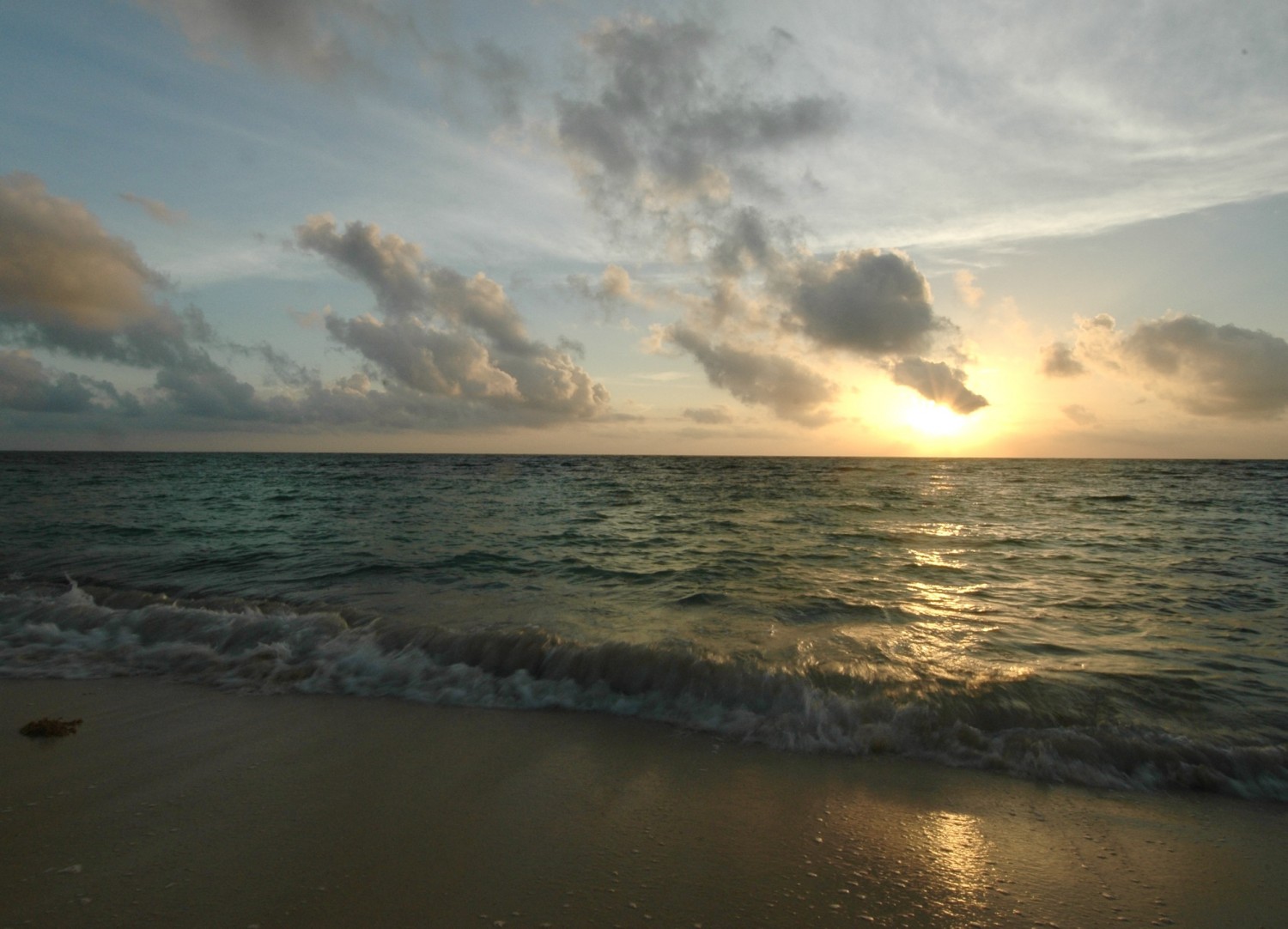 |
| MEXICO: Dawn; Sian Ka'an Preserve |
Radiance
I wake up, for no clear reason. Then it hits me: that thermos of water I drank last night is back. Sleep retreats, and in its place is a recognition that I’m going to have to get up. I remember now where I am, and it makes this urgent need a complicated mission. I’m sleeping solo in a tent on remote Isla Espiritu Santo—Island of the Holy Spirit—camped on a narrow beach, in the Sea of Cortez, Mexico. I paddled a kayak here today with others, all women. Stretching awake in my sleeping bag, I sit up, wondering about the route for the task ahead of me. It needs some planning.
We reached our overnighting spot mid-day, paddling in from a small nearby island in this marine archipelago. On our way we glided our kayaks over waters in a shallow bay, lingering to look for sea turtles feeding there. Dipping paddles lightly, we hovered silently on aquiline-clear waters, catching glimpses far below of turtles nibbling sea grass on the green bay bottom.
An hour later, we made our landing on Espiritu Santo. The silence of this island drew us in as we landed, lifting our gaze to raw, peach-colored cliffs that dropped down into shrubby desert plants, that finally gave way to a narrow strip of beach.
I notice now, through my tent window, that the same thread of beachline is much thinner with the incoming tide. We’d been told by our guide, Leah, that the beach would be deep enough for all of us to safely camp there through high tide, but that we needed to pitch our tents with care, closer to the desert shrubs. We staked them in a line, near the back edge of the beach.
Leah is our guide, and the sort of person who knows the exact nature of any area she’s in. We shared stories each evening while we prepared dinner together, and Leah’s were about kayaking alone, paddling from Alaska down through the Inland Passage to British Columbia. Leah lives in Baja during the spring months, guiding for the all-women’s expedition company that made it possible to be here. Most women on this trip have either come alone, as I have, or with a friend, or in one case, as a mother and daughter pair.
Several days in, we’ve camped the whole time and at the moment of waking in my tent on Espiritu Santo, it’s been at least four days since I’ve had a warm shower, not counting dips in the cool salty ocean. Yet I’ve felt clean, clear, solid. I’m the only beginner kayaker here. Learning to paddle and work as a team has been tiring and challenging, yet I’ve hardly ever felt more alive. And to think I almost cancelled because of fatigue from a lingering respiratory infection.
Yet it was a different fatigue that propelled me to come in the first place. My ninety-four year old mother died four months ago, after years of a slow decline and increasing disconnection from her three daughters, as she turned inward toward her own troubles she never shared. In spite of that withdrawal, she needed help. It was frustrating to care for her, to try to reach a person so unwilling to be reached. I’d never felt close to her growing up, and neither had my sisters. Yet I’d longed for that more than any of them, and spent years driving from my home in New Mexico to her home in Arizona before moving to the Pacific Northwest.
From there, I travelled south to the desert often, spending time with her in ways that worked just a little, for just a while. Years of spiritual practices had softened me toward her. It helped me feel and know the holy feminine spirit of Shakti that illumined us both; making visits easier as I saw more deeply into her life, and accepted what she could offer. She’d clip out hikes for me from the local newspaper and save them in a manila folder in her living room, setting it down on the coffee table after each addition. Each one bore the date in the top right corner that noted when she’d cut it out of the paper. She knew I’d find and flip through the folder after she’d gone to bed. Her writing on those corners grew shaky, were spelled out in thicker ink as her eyesight failed.
Sometimes I’d go on one of those hikes and tell her about it at dinner that night. She beamed to know that she had found this trail, this place I went to, as if it gave her a window into being there beside me. It was that layer of safety and distance that she required in order to relate to me, that distance that let her observe me, without a need to risk anything, without interacting very much. It was like that during those years.
Sitting up now, I sigh and finally crawl out of my sleeping bag, toward the tent door. On hands and knees, I zip the door open and peer into the darkness, looking before I step outside. Zipping the door shut behind me—who knows what night critters might want inside—I stand up, into the night sky. The sound of the surf is strong. The tide must be high now, close to dawn, but the inky black sky is silent, giving no clue.
As we were settling down around sunset, the two women in the tent next to mine worried that Leah might be wrong, that we might be overtaken by the ocean in the middle of the night. I trusted Leah, but agreed that setting up a visual barrier in front of our tents was a good safety marker. We three gathered the largest rocks we could carry, and with our tents shoulder to shoulder, parallel to the ocean, we set up a small, stone fence in front of them. This created a visible reading of how close the tide actually was. Chantelle, in the tent next door, was on her third sea-kayak paddle. She’d set her wrist alarm for the “high tide” mark, and check our rock barrier to be sure we were safe. Trusting Leah and now Chantelle to watch the tide, I turned in at the end of the evening, exhausted, and fell asleep in moments.
Until now.
My thoughts turned again toward my mother’s life as I stood enveloped in the dark night sky in front of my tent, breathing the night air. Knowing her love of gardening, I’d cultivated a shared garden of words with her over time. I’d write her about the drought-resistant buffalo grass I was trying in my New Mexico yard, about the Maximillian perennial sunflowers that grew tall in late summer, and flowered up the stems, like hollyhocks. I thought she’d like them too, and she agreed. When I moved to the Pacific Northwest, I told her about the roses I bought and planted, the blooms growing so large, so rich in color under the clouds of a rose-loving sun, something rare in the burning light of my desert home.
I turned my flashlight on now and shined it at the sand and walked down to the ocean’s edge to find the tide line. I passed wet sand on the ocean side of our rock fence, telling me high tide has come already and retreated, and we were safe. Small crabs darted here and there, making way for my feet—a fearful truce between us—as I headed toward the water, to a far rocky outcropping of boulders that looked sheltered enough. The ocean was gentle here, but I couldn’t see it clearly, and hoped a wave wouldn’t knock me over.
Afterward, satisfied with my small nocturnal adventure, I stood at the tide line and looked around. The stars and the quiet enveloped me, and drew me into the crystalline clear night, into the cosmos above me. My eyes moved from the faint stars to the blackness of the night as the carpet of stars continued to break itself open and light up.
* * * * *
My mother loved the stars, too, rising alone at terrible hours during meteor showers to watch them flash across the silent, desert sky.
* * * * *
Stars, everywhere in this inky blackness. Some brighter ones here, some barely visible ones across the horizon, there. If I hold my breath and become animal-still, they show themselves more, like shy jewels; becoming more visible as I seek them out. I see how they outline the night sky, and the horizon, too. I can trace where the sky ends and sea begins, by the absence of stars. To the left and right of me, the now darkened cliffs of Espiritu Santo are the same—revealed only by the black velvet vacuum of no stars. Watching the cliffs this way, I make out their shape by where the stars stop. How wonderful!
Smiling at this secret discovery, I glance down to where my feet touch the surf’s edge. And what is this? Something shining. And sparkling now, with the touch of each wave. I look away and then back. No, it’s still there. The glow runs all along the wave line. As each wave touches the shore, a chain reaction of light sparks along the surf line of the beach, all the way to the bay. I look the other way, and see the same glow running up the beach to the cliffs.
Suddenly I’m watching the miracle of bioluminescence, of small ocean organisms responding to the turbulence of waves. This recognition prompts me to look out to sea, to the edge of the horizon where stars begin, over the ocean. There are stars in the sky, and now I see a different kind of stars here, in the water’s lacey edge. Everywhere I look, radiant stars appear. Beauty overwhelms me, bringing tears to my eyes as I watch. My mother’s death four months ago lead to this trip, lead me to come here to wash myself clean of this grief, to baptize myself over and over again in the salty ocean of tears and stars; to mourn a mother I didn’t really know but missed, knowing her love of nature, of stars.
No longer resisting the pain of this complicated loss, the cloud of my grief relaxes and opens. Soon the presence of the goddess Shakti’s energy invites me to join her and I do, seeming to fall outward, riding the energy arising from somewhere deep in my belly and now filling the warm, soft night. The primordial Shakti feminine energy of the cosmos becomes the unimpeded Being that She is—the night sky, the ocean, me standing quietly on the beach within the cliff walls. The presence of my mother somehow joins me under the shining stars, and I feel her there with me. Shakti holds it all, listening inward and looking outward through my eyes, seeing all that I see.
I breathe in the moist night air, my toes tunneled under cool, wet sand and rest in the fullness of the luminous night. I am That which is also me, and is my mother, too. And all of the women here too, sleeping softly on the beach. We are the shapes of the feminine force of creation.
Moments pass. I exhale, a bit lighter now, and retrace my steps to my tent. I look back from there, but the glowing surf line has vanished from view. I tell the sea lights good night, breath in the stars, and just to be sure, check the high tide line by my fellow camper’s safety line of rocks. The glow of the night’s adventure fills me as I crawl back into my sleeping bag. In a short time, I fall back to sleep.
The goddess Shakti closes her eyes with me, around me, around the island of Espiritu Santo and further on. The Holy Spirit holds us all, as the universe of miracles disappears into the edge of dawn.
< Return to Writings Main Page