Snapshot
April 10, 2025
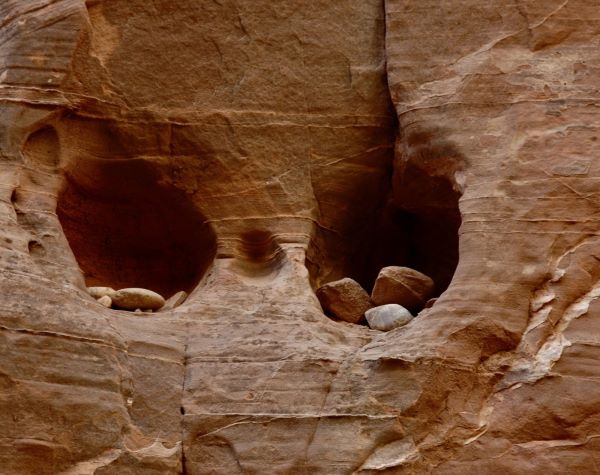 |
| Rock In Holes After Flood, Colorado Plateau |
I’d been inside before, but stood outside now, waiting for my partner to emerge with a horde of photographers. I looked back into the narrow, red rock slot canyon. Stepping inside lead into a winding chamber of ever-changing sandstone colors. Water and time had carved it into a sensual, twisting world, steps away from an ordinary desert view. The slow movement of the sun above the sheer canyon walls lit up the narrow passageway in an ever-changing kaleidoscope of pinks, reds and oranges.
I was almost certain I had some good shots. Opening my camera bag, I wiped the front and back of each hand to free them of the red dust particles that stuck to everything. It didn’t take much to wreck camera gear. I took off my new close-up lens, put it in its case, sat the lens and camera body inside, then tucked a small cloth around it all and buckled it up. With the bag at my feet, I leaned against the canyon wall. Glancing again toward the slot canyon entrance, I waited.
A wide-open vista unfolded in the other direction from the canyon and native plants sprawled across the plain. Indian Ricegrass, yucca plants and sagebrush grew on low spreading dunes of pinkish sand. An indigo sky watched unblinkingly overhead, and a breeze brushed lightly across the landscape.
Soon, a tall, large Navajo man came out alone. Jim was our Navajo guide into the canyon. His long black hair was tied up with white cord, in a traditional bun. It hung neatly at the back of his head. A large, black hat shaded his head and part of his face. We were on Navajo Nation land, and their rules required a Navajo guide to accompany all visitors.
“Hi,” I said. “Everyone’s still inside?”
He looked over at me, pausing at the bag at my feet. “Yeah, they’re in there, alright. Still pretty far in. Taking their time.”
“Okay.”
He sat his day pack down at his feet, and leaned into the canyon wall a few feet from where I stood.
“How come you’re not in there, too? Don’t want any photos?”
I sighed. “Well, it’s pretty hot. I took a lot, though. But there’s a lot of people in there. Hard to get shots without someone’s feet or head in them.”
“Yeah, that’s why I broke the group up in two. The Japanese group was the biggest, so I had them go first, so they could talk and keep out of each other’s way.”
“Well, I’ve been here before anyway.”
“You have? So too many pictures?”
“Not really. I don’t have all that many, but I’ve been here a lot without a camera. I’m from here, actually. I grew up in town, but live in Oregon now. My partner knew about this place, though, and wanted to come see it. So, I brought him here.”
He turned toward me, surprised. He looked me over, probably trying to see if he could remember me from somewhere. “You grew up here?”
“Yeah. It’s weird, almost no one’s from here. I haven’t been out to this canyon for over twenty years. I lived here from kindergarten on. We moved here around ’65. The town had maybe a thousand people then. My dad helped build Glen Canyon Dam. When I was a teenager, some friends and I would come out here in a four-wheel drive. We’d smoke a little pot, drink beer, you know.”
Jim smiled. “Yeah, the Tribe knew local kids came out here. They didn’t put a fence up and start charging to go in until this place got famous from magazine photos. People come here from everywhere. Mostly from Japan and Germany.”
“Yeah, I know. I don’t remember knowing back then it was tribal land, though. Sorry.”
Jim glanced over at me. “It’s okay. We’re used to it by now. You know?” I nodded. “It didn’t really need a fence anyway until it got famous.” His face was blank, unreadable.
“It is gorgeous,” I said. “Sort of unreal. Like being inside the body of Mother Earth. I came here too because it was peaceful, which is what my home was not. It was a place to hang out for a while. There’s a lot of slot canyons, but this one’s close to town.”
“Your home was a bad place?”
I brushed my hands off and turned toward Jim. “Yeah, it was bad. But not all the time. Did you ever know Mrs. Smith? She was the kindergarten teacher. I still remember her. She was a nice lady.”
“Huh. No. I was living over there out toward Kayenta.” Jim pointed with his chin out across the landscape toward the southeast. “I was at the boarding school back then.” His face clouded up. “It was a bad place, too. I moved into town and lived with my aunt in a transa house in ’67. You remember the transa houses?”
“Yeah. Like little train cars. They were at the dam construction site in the early days. They moved them into town before I got there. I saw them across the open desert from my house on Birch Street, though.”
“Yeah. That’s where I was living.” He paused. “Did you know Mrs. Bybee? Third grade? She was a big woman. A good teacher, but short and round and loud, too.”
“Are you kidding? I remember her. Yeah, she was big. She had a big head of hair, too. It was really red.”
“Yeah! Like a red beehive.”
“Uh huh.” We smiled at each other, then fell silent, leaning up against the cliff, lost in our own memories. A raven cawed overhead. A breeze gusted across the field in front of us. I reached down to check my bag.
“I just remembered a story about her,” I said, turning toward the silent man. “Want to hear it? It’s about me and a friend. But Mrs. Bybee is in it.”
Jim turned to see if anyone else was emerging from the slot canyon, but it was still quiet. “Yeah! I want to hear it.”
“Okay. Well, my friend Cecily and I were at the Mormon Church one evening. We were. . . maybe fourteen. Her mother made her go to a youth group there, because she was always getting in trouble, but she didn’t like it. I went along to keep her company. Mrs. Bybee was in charge of it, at least that evening.”
Jim’s eyes grew big. “Mrs. Bybee was there?”
“Yep. She sure was. So anyway, Cecily’s mom drops us off, and we go in and find the room. After a minute my friend says, ‘Let’s get out of here!’ So, we took off, when Mrs. Bybee was looking the other way. We went down the hall into the women’s restroom, where Cecily turned the lock on the bathroom door, and lit up a cigarette. I did, too. We turned the hand dryer on. I guess we thought it’d blow out the smoke.”
“You girls were trouble!” Jim’s face was lit up in a smile by now.
“Yeah, we could be. It gets better. Or, worse, maybe.” I looked at him, as he stood there grinning, no longer leaning against the cliff. “Anyway, it was just a minute or two when someone banged loudly on the door. Yes!— it was Mrs. Bybee. She must have seen us leave.
‘Are you girls in there?’ she yelled. ‘Open this door right now!’
‘Just a minute, we’re almost done,’ we said, flushing our cigarettes down the toilet and looking around. “I was scared, but Cec wasn’t. She never was.”
‘Look,’ my friend said, staring at what I thought was the back wall. The bathroom was dimly lit. It only had two stalls, but it had a corridor past the stalls we hadn’t seen. At the end of that was a back door. ‘Ha!’ She said. Cec had a way of getting into, then out of, trouble. Anyway, the door was locked, but from our side. She flipped the lock open. ‘Ok, I’ll shut the lights off in here, you flip the lock near Mrs. Bybee, and we’ll take off this way.’ So, we did. It was dark, we couldn’t see at all, and we went out in the same moment that Mrs. Bybee came in the opposite side, yelling ‘You girls were smoking! Stop right now!’
But we were in that next room. It was dark there too, and we didn’t see a light switch. We kept going. There was a handrail in front of us, so we grabbed it, and went down some steps. Into cold water! Up over our knees! We waded across a full baptismal font—you know the Mormons do full-body baptisms?”—Jim nodded. “We found the other hand rail, and in soaking wet tie-dyed jeans, pulled ourselves out, dripped across the carpet with Mrs. Bybee somewhere behind us.”
Jim was staring at me. “Did she get wet, too?”
“I don’t know! I was scared, and just moving. We found a door into a hallway, though, and saw big glass doors that lead outside. We ran. When I turned around to look, wet footprints trailed down the carpet behind us. Mrs. Bybee was way back there, still screaming, ‘Stop!’ Of course, we kept running, and ran all the way outside, and kept running until we couldn’t. Mrs. Bybee didn’t follow us. I wasn’t so scared then, and we both doubled over, laughing, out of breath. My friend’s house was pretty close, so we walked there. Our pants dried on the way. And her father, who drank too much and got mean when he did, wasn’t home, which was a very good thing for my friend. But we never, ever went back there. Mrs. Bybee knew us both from school, but nobody ever called our parents. Nobody ever said a thing.”
Jim looked at me, his large sides shaking with silent laughter. He stopped, winded, and stood there a few moments, nodding his head. We stood looking out over the desert together.
Then Jim turned toward me, his hand out. I took it, looking into his warm, open face. He shook my hand, and kept on shaking it. “Welcome home,” he said, smiling.
< Return to Writings Main Page